

Most internal audit teams can name the three or four classic control categories. Far fewer can explain why those categories matter for resource allocation, why preventive bias is a hidden risk, or what changes when continuous monitoring blurs the line between preventive and detective.
Categorization is not a vocabulary exercise. It drives where testing budget goes, which controls get automated first, how SOX documentation holds up under PCAOB scrutiny, and whether the next external audit surfaces nasty surprises.
Internal controls can be classified across four dimensions - function, objective, scope, and implementation - through the lens of the COSO internal control framework. Each dimension exposes different failure modes, drives different automation strategies, and matters for different reasons.
What are internal controls?
Internal control is the set of processes, policies, and activities that organizations use to manage risk and achieve their objectives. The COSO framework defines it as a process effected by an organization's board, management, and personnel - not a department, not a checklist, and not a software platform.
Internal controls serve four core purposes:
- Safeguard assets against loss, theft, and misuse
- Ensure accurate financial reporting in line with GAAP or IFRS
- Maintain compliance with laws, regulations, and contracts
- Support operational efficiency across business cycles
According to COSO, internal control rests on five integrated components: control environment, risk assessment, control activities, information and communication, and monitoring activities. The 2013 update added 17 supporting principles to clarify how each component should operate.
A subtle but important point: a "control" is not the same thing as the risk it addresses. The same activity - say, an account reconciliation - is a different category of control depending on which risk lens it is viewed through. That ambiguity is exactly why categorization matters.
Why categorizing internal controls matters
Classification is not bureaucratic housekeeping. It directly affects how effectively teams cover risk and how efficiently they audit it.
- Structured risk coverage - categorization exposes blind spots before they become findings
- Resource prioritization - testing effort flows to the highest-risk control types
- Auditor communication - external auditors and regulators expect clear classification taxonomies
- SOX documentation - ICFR requires evidence of both entity-level and process-level controls
- Automation readiness – properly classified controls are easier to digitize and monitor continuously
The stakes are real. According to the ACFE's 2024 Report to the Nations, more than half of occupational fraud cases occur because internal controls were lacking or were overridden. Categorization is the first step toward closing those gaps - the second is making sure the classification reflects the risk the control actually mitigates, not the activity in isolation.
A reconciliation classified generically as "detective" tells an auditor very little. A reconciliation classified as detective for completeness of revenue recognition tells an auditor exactly what residual risk remains and what compensating controls are needed.
Internal control categories by function
The most widely used classification groups controls by when they act relative to a risk event.
Preventive controls
Preventive controls stop errors and fraud before they happen. They are the first line of defense and the most cost-effective category in theory - stopping a problem is always cheaper than fixing it.
In practice, the cost calculation is more complicated. Heavy preventive control environments create approval bottlenecks, drive workarounds, and slow business cycles. A purchase order routing through five levels of approval feels safe but pushes business users toward emergency POs, after-the-fact processing, and shadow procurement - all of which create new risks the original control was never designed to cover.
Concrete examples in finance:
- Segregation of duties - the person who creates a vendor cannot approve payments to that vendor
- Approval workflows with authorization thresholds on journal entries and purchase orders
- Access controls restricting who can post to the general ledger
- Three-way matching between purchase order, goods receipt, and invoice before payment
The right design question is not "how many preventive controls do we have?" but "where does prevention stop being worth the friction?" High-volume, low-value transactions usually deserve detective-heavy designs. Low-volume, high-value transactions justify preventive overhead.
Detective controls
Detective controls identify issues that have already occurred. They catch what preventive controls miss - and no preventive control is perfect.
The interesting twist: most controls labeled "detective" in standard documentation are actually preventive for a downstream risk. A monthly bank reconciliation is detective for posting errors but preventive for misstated cash balances on the financial statements. That dual nature is why function-based classification only works when paired with the objective lens.
Examples include account reconciliations, variance analysis, exception reports flagging weekend postings, duplicate payment detection, and audit trail reviews. Transaction anomaly detection is a modern detective control that scans every transaction rather than a sample – which fundamentally changes its risk profile, since detection latency drops from weeks to hours.
Corrective controls
Corrective controls remediate issues once they are detected. They restore normal operations and prevent recurrence.
Corrective controls are the most underdocumented category in most SOX frameworks. Audit teams document the preventive control (approval matrix) and the detective control (exception report) but rarely document the corrective control (what happens when the exception report flags something). That documentation gap is exactly what regulators and external auditors increasingly probe.
Examples: incident response procedures, audit finding remediation plans, process adjustments after control failures, financial restatement workflows, and disaster recovery procedures. The strongest corrective controls have named owners, defined SLAs, and evidence trails - not just "process to be followed."
Directive controls
Directive controls are often dismissed as soft. The data says otherwise.
They are the policies, guidelines, and training that set expectations across the organization: code of conduct, accounting policies, internal control manuals, fraud awareness training, whistleblower hotlines. The ACFE found that having a code of conduct in place reduces fraud losses by 56% - a stronger ROI than most technical controls deliver.
The reason directive controls outperform expectations is that they shape behavior at scale. A single approval workflow catches one transaction at a time. A clear escalation policy combined with anti-retaliation protections changes how thousands of employees behave when they see something wrong. Treating directive controls as "checkbox compliance" leaves significant risk reduction on the table.
Internal control categories by objective (COSO framework)
COSO classifies controls by the objective they support. Every control should map to at least one of these three categories - and a single control often maps to multiple, which is where the dimension becomes powerful.
Operational controls
Operational controls support business efficiency and effective use of resources. Examples: production scheduling, inventory management, quality assurance checkpoints, and capacity planning.
Operational controls rarely appear in SOX scopes, which is exactly why they create surprise risk. An inventory control failure that is "operational" in nature can produce material misstatements in cost of goods sold - at which point it becomes a financial reporting problem retroactively.
Financial reporting controls
These controls ensure the accuracy and reliability of financial statements - the heart of financial reporting and internal control. Examples include journal entry approvals, close checklists, account reconciliations, and disclosure reviews.
ICFR (internal controls over financial reporting) is a subset of this category and is the focus of SOX 404. Not every financial reporting control is an ICFR control - the distinction usually comes down to materiality and the assertion being supported.
Compliance controls
Compliance controls ensure adherence to applicable laws and regulations. Examples: SOX 404 testing, anti-fraud monitoring under FCPA and Sapin II, GDPR data privacy controls, and tax compliance routines. Internal control compliance often involves overlapping regulatory regimes across jurisdictions, which creates a documentation problem most frameworks underestimate.
The same vendor onboarding control might satisfy FCPA, anti-money-laundering, sanctions screening, and tax requirements simultaneously. Mapping a single control to multiple regulatory objectives is one of the highest-ROI documentation exercises an audit team can do - it reduces test duplication and surfaces gaps where a regime is uncovered.
Internal control categories by scope
Scope distinguishes controls that operate organization-wide from those embedded in specific transaction cycles. PCAOB Auditing Standard 2201 requires auditors to use a top-down approach that evaluates both entity-level and process-level controls - not because both exist, but because the strength of one directly affects the testing required for the other.
Entity-level controls
Entity-level controls operate across the entire organization and shape the overall control environment.
Examples of these types of controls include:
- Tone at the top
- Ethics programs
- Enterprise risk management framework
- Audit committee oversight
- Board independence
- Whistleblower mechanisms.
Strong entity-level controls reduce the testing burden on process-level controls. Weak entity-level controls do the opposite - external auditors expand process-level sampling precisely when they cannot rely on the environment above.
Process-level controls
Process-level (or transaction-level) controls sit within specific business cycles and act on individual transactions.
Common cycles include:
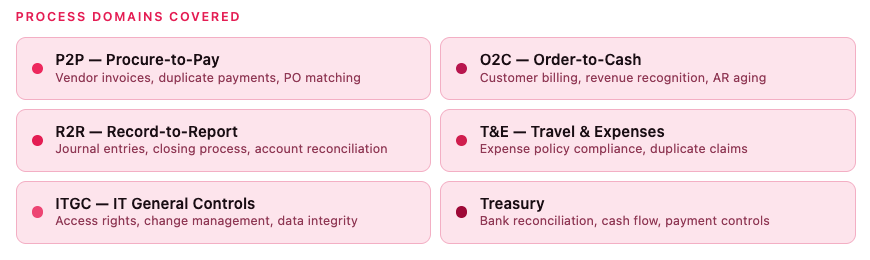
- P2P (procure-to-pay) - vendor master controls, three-way matching, payment approvals
- O2C (order-to-cash) - credit limits, billing accuracy, cash application
- R2R (record-to-report) - journal entry controls, reconciliations, close certifications
- T&E (travel and expense) - policy enforcement, receipt validation, duplicate detection
- Treasury - payment authorization, bank reconciliations, FX controls
Process-level controls are where automation delivers the most measurable value, because the volume is high and the logic is repeatable.
Internal control categories by implementation
Implementation distinguishes how the control is executed.
Manual controls
Manual controls are performed by people - a controller reviewing a reconciliation, a manager signing an approval form. They are flexible and can handle judgment-heavy decisions, but they suffer from human error, fatigue, and limited scalability.
The honest assessment of manual controls is that they are tested through inspection of evidence (signatures, sign-offs, screenshots) which often demonstrates that the activity occurred without demonstrating that it was done well. A manager who signs every approval without scrutiny passes the test and fails the control.
Automated (IT application) controls
Automated controls are built into systems and execute without human intervention. Examples: ERP validation rules rejecting invoices above a threshold, automated three-way matching, system-enforced segregation of duties, and approval workflows triggered by transaction attributes.
These controls scale infinitely and produce a clean audit trail - critical for accounting and internal control at high transaction volumes. The trade-off is configuration risk: an automated control with a misconfigured threshold fails silently and consistently across millions of transactions, which is materially worse than a manual control that fails inconsistently.
IT general controls (ITGCs)
ITGCs are the foundation that makes automated controls trustworthy. If ITGCs fail, every automated control above them is in question. Internal control and IT covers four main domains:
- Access management - user provisioning, privileged access, periodic reviews
- Change management - approval and testing of system changes before production
- IT operations - job scheduling, monitoring, incident management
- Backup and recovery - data protection and business continuity
The most common ITGC failure pattern in audit findings is change management - specifically, emergency changes that bypass standard approval. When that pattern shows up, every automated financial control downstream needs revalidation, which is why ITGC weaknesses cascade into expensive remediation programs.
How internal control categories work together
Real control environments are layered. A single high-risk activity - say, a manual journal entry - is covered by controls across all four dimensions simultaneously.
A matrix view exposes gaps quickly. If a control only appears in one row, the activity is under-protected.
Consider a duplicate vendor payment that clears the bank before anyone notices:
- Preventive control that should have caught it: the ERP duplicate-invoice check. It failed because the second invoice used a slightly different invoice number format that the configured matching logic did not recognize.
- Detective control that did catch it: a periodic exception report flagging multiple payments to the same vendor within a short window. It surfaced the issue, but only after the payment had already cleared.
- Corrective control that recovered the funds: the AP team's vendor-recovery process, which depended on the vendor's cooperation and took weeks to resolve.
- Directive control that should have prevented the conditions: the AP policy on invoice number normalization, which existed but was not consistently followed by staff entering invoices.
- Entity-level factor: the absence of a finance-wide control owner for AP exception trends meant similar issues had been recurring without being escalated, investigated, or fixed at the root.
Every dimension contributed something. None alone was sufficient. A layered environment depends on every dimension functioning together - classifying controls along only one creates false confidence.
Common mistakes when classifying internal controls
Even mature organizations fall into the same traps:
- Over-relying on preventive controls without detective backup - preventive controls fail silently, and the cost of friction is rarely measured against the risk reduction
- Ignoring directive controls - policies exist on paper but are not enforced or trained on, despite being among the highest-ROI categories per the ACFE data
- Treating ITGCs as an IT-only concern - when they fail, every financial automated control is invalidated, and the cleanup is finance-led
- Classifying controls without linking them to specific risks - classification becomes a paperwork exercise that satisfies documentation requirements without improving coverage
- Manual-only approaches that cannot scale across multiple entities, ERPs, or geographies, leaving the largest transaction populations effectively untested
- Confusing activity with effectiveness - a control that is performed is not the same as a control that works, and most documentation captures the former
How to automate internal control testing across categories
Traditional audit relies on sampling - testing 25 transactions out of millions and extrapolating. That approach misses anomalies hiding in the unsampled 99.99% and cannot keep pace with modern transaction volumes. It also creates a structural blind spot for fraud, since fraud schemes are designed to evade sampling.
Continuous control monitoring shifts the model. The IIA's GTAG on Continuous Auditing and Monitoring describes how analytics-driven testing of full transaction populations replaces periodic sampling and delivers near-real-time assurance.
Continuous monitoring also blurs the function-based taxonomy in interesting ways. A real-time anomaly scan that flags a duplicate payment within minutes of posting is technically detective - but at that latency, the practical effect is preventive, because the payment can be stopped before the funds clear. The categories stop being mutually exclusive when detection happens fast enough.
Audit analytics platforms apply automation across every control category:
- 100% transaction testing across all categories - not samples
- Real-time anomaly flags (detective automation) - duplicate payments, weekend postings, round-number journals
- Automatic segregation of duties enforcement (preventive automation) - conflicts surfaced before transactions post
- Remediation workflow tracking (corrective automation) - findings routed, owned, and closed
- Standardized controls across geographies and ERP systems - the same logic runs on SAP, Oracle, NetSuite, and Workday
Supervizor ships 350+ out-of-the-box controls spanning P2P, O2C, R2R, T&E, ITGC, and Treasury. Teams deploy them in days rather than building libraries from scratch, and the platform integrates directly with major ERPs to apply continuous control monitoring software to full transaction populations. Fraud prevention controls run continuously rather than during quarterly cycles - which matters because internal control software only delivers value when it covers every transaction, not a sample.
Conclusion
Internal controls can be classified along four complementary dimensions: by function (preventive, detective, corrective, directive), by objective (operational, reporting, compliance), by scope (entity-level, process-level), and by implementation (manual, automated, ITGC).
The dimensions matter not because they fill out a documentation grid, but because they expose different failure modes. A control library viewed only by function misses the cascade risk in ITGCs. A library viewed only by objective misses the friction cost of preventive bias. A library viewed only by scope misses the directive controls that the ACFE data shows are among the strongest by ROI.
A mature control environment uses every dimension at once and tests them continuously rather than annually. Manual sampling cannot keep up with modern transaction volumes or regulatory expectations, and the gap between annual testing cycles and real-time risk is exactly where modern fraud schemes operate.
Audit and finance teams ready to move beyond spreadsheet-based testing should evaluate platforms that automate full-population testing across every control category. Supervizor delivers 350+ pre-built controls for exactly that purpose.



.jpg)