

Periodic, sample-based testing was built for small transaction volumes and annual audit windows. A control failure in February surfaces during the year-end audit in November – nine months of undetected exposure, and a remediation program that arrives too late to prevent a restatement.
Continuous controls monitoring (CCM) replaces that lag with automated, full-population testing against live transactional data. Most published material on CCM is written for cybersecurity teams; the financial controls angle is where the impact on internal control programs is largest and least covered.
What is continuous controls monitoring (CCM)?
CCM is a technology-driven approach that automatically and continuously tests internal controls against the full population of transactions, rather than relying on periodic, manual, sample-based reviews. The output is a steady stream of pass/fail signals, with exception lists flowing to investigation queues when something breaks.
CCM, one element of continuous assurance, tests control effectiveness, continuous data assurance verifies data integrity, and continuous risk monitoring tracks live exposure. COSO's 2013 Internal Control – Integrated Framework provides the structural grounding: monitoring activities is one of the five components, and CCM is how that component is operationalized at scale.

Periodic auditing vs. continuous controls monitoring
The shift from periodic to continuous changes the population tested, the latency of detection, and the cost trajectory.
The headline issue is detection lag. The Association of Certified Fraud Examiners' (ACFE) 2024 Report to the Nations found a median 12-month fraud duration, with internal audit catching 14% of cases and external audit just 3%.
Sample coverage is also worse than it looks. A 25-transaction sample from 5 million is 0.0005% coverage – no defense against a scheme designed to evade sampling. A $4,999.99 split transaction in a $5,000 approval environment will never appear in a random sample.
CCM does not replace the annual audit. It changes what auditors do when they arrive – they work with evidence rather than collecting it.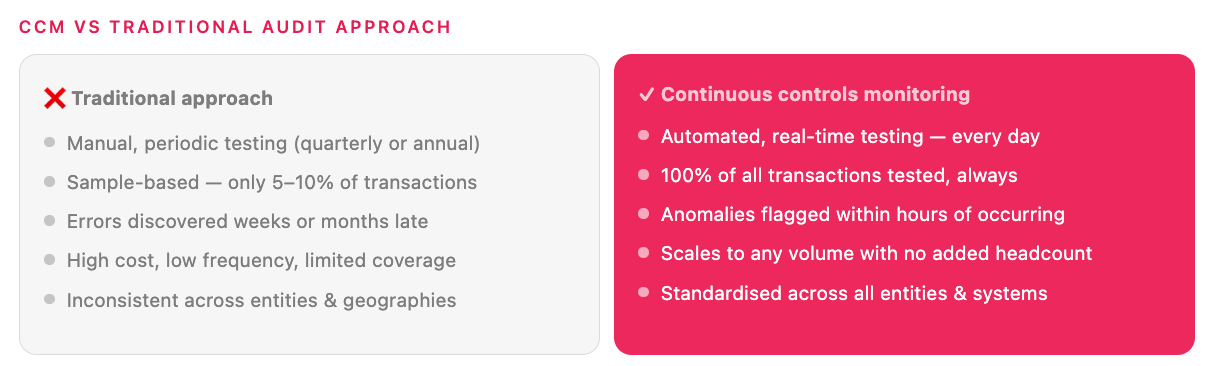
Why continuous controls monitoring matters now
Regulatory pressure is increasing
Sarbanes-Oxley Act (SOX) Section 404, UK SOX, Sapin II, and the Foreign Corrupt Practices Act (FCPA) require evidence of control effectiveness, not just documentation. The Public Company Accounting Oversight Board's (PCAOB) AS 2201 conditions auditor reliance on the quality and timeliness of that evidence. Internal control compliance programs increasingly need a continuous evidence trail to meet those standards, not point-in-time attestations.
Business complexity is outpacing manual testing
Multi-entity organizations now run two to five enterprise resource planning (ERP) systems after years of acquisition activity. Sample-based testing produces inconsistent coverage across entities, with the highest-risk subsidiaries often the least tested because their data is the hardest to access.
Fraud and errors are costly when caught late
Organizations lose roughly 5% of revenue to fraud annually, with a median loss of $145,000 per case. Catching a duplicate payment in the week it occurs is recoverable; catching it nine months later usually is not. Fraud prevention controls that run continuously close that recovery window.
The three lines of defense need real-time data
First line needs alerts, second line needs oversight dashboards, and third line needs continuous evidence. The same data set feeds all three, but each group uses the output differently – which is why ownership and governance of CCM outputs matters as much as the detection logic itself.
What does CCM monitor in practice?
The largest unaddressed value sits in financial process controls, where transaction volumes are highest and detective sampling is weakest.
Procure-to-pay (P2P)
Duplicate invoices, payments without matching purchase orders, vendor master anomalies – such as the same bank account appearing across multiple vendor IDs – and three-way matching failures. P2P delivers the fastest cash recovery because duplicate payments are typically traceable and recoverable within the same period.
Order-to-cash (O2C)
Credit limit breaches, unauthorized discounts, revenue cutoff anomalies, and unusual write-offs. O2C exceptions typically surface as revenue recognition risks in the audit scope.
Record-to-report (R2R)
Unusual journal entries, intercompany imbalances, and reconciliation exceptions. Round numbers, weekend postings, and suspense-account entries are invisible in a sample and obvious in a 100% scan. The accounting and internal control discipline covers the R2R control design in detail.
Travel and expenses (T&E)
Policy violations, duplicate claims, split transactions below approval thresholds, and submissions for non-employees. T&E amounts are typically small, but the pattern of exceptions is a reliable indicator of control culture.
IT general controls (ITGCs)Internal control compliance
Access violations, segregation of duties (SoD) conflicts, and emergency changes that bypass standard approval workflows. ITGC failures cascade: when access management breaks down, every downstream automated financial control requires revalidation. Internal control and IT covers the four ITGC domains in depth.
Treasury
Bank reconciliation exceptions, unauthorized payment methods, foreign exchange (FX) anomalies, and unusual cash movements. Low volume, high value: one missed treasury exception can exceed a full year of T&E findings combined.
CCM outputs need clear ownership and defined escalation paths from day one. A weekend posting can indicate fraud or a misconfigured batch job – the signal is the same, but the investigation route differs.
Key benefits of continuous controls monitoring
Full visibility across 100% of transactions
Every record tested, no inference from a sample. The output shifts from "effective at 95% confidence" to "passed on 4,999,873 of 5,000,000 transactions; here are the 127 exceptions." That specificity changes how audit findings are communicated and how quickly they are resolved.
Faster detection and remediation
Median detection drops from weeks to hours. Remediation compresses too, because exceptions arrive while the context is fresh and the transactions are often still reversible.
Lower cost of compliance over time
Year one rarely beats legacy costs. By year two, automated tests run without incremental effort and teams shift to investigation and root cause analysis, closing the activity-vs-effectiveness gap that manual testing never resolves.
Stronger audit evidence
Continuous test logs against full transaction populations are materially more reliable than sampling reconstructed after the fact – particularly for financial reporting controls and internal control over financial reporting (ICFR) assessments.
Cross-entity and cross-ERP consistency
The same control logic runs uniformly on SAP, Oracle, NetSuite, Workday, and Dynamics. Inconsistency across entities is among the most common findings in multinational audits and straightforward to eliminate with purpose-built continuous control monitoring software.
Shift from reactive to proactive risk management
When detection lag drops to hours rather than months, failures are intercepted rather than reported – shifting the conversation from "found in last year's audit" to "caught Tuesday."
How to implement continuous controls monitoring: a step-by-step roadmap
Step 1 - Identify high-risk controls to monitor first
Start with controls tied to the highest-impact risks: financial reporting, fraud, and regulatory compliance. The risk register and current audit plan are the inputs.
Step 2 - Map controls to data sources
Each control needs a live feed from the underlying transaction system – process documentation alone is not sufficient. Catalog the ERP, sub-ledger, or feeder behind each control before selecting a platform.
Step 3 - Choose the right CCM approach
Two routes exist: build custom analytics from scratch, or deploy a platform that ships ready-to-run controls. Custom builds stall most often in data engineering rather than analytics - ERP-specific data models consume months before any control logic runs. Packaged internal control software shortens that path significantly.
Step 4 - Define thresholds and alerting rules
Define what counts as a finding before controls go live - materiality levels, risk weighting, and escalation paths from the start. A practical benchmark from mature programs: 50–100 exclusion rules per quarter in year one, declining as rules are refined and false positives are suppressed.
Step 5 - Assign ownership and remediation workflows
Every alert needs an owner, an investigator, and a closure standard. The most common failure is an alert pipeline with no defined consumer - exceptions accumulate unread and the program loses credibility quickly.
Step 6 - Integrate with your existing GRC and audit workflow
CCM outputs should feed into the governance, risk, and compliance (GRC) platform and audit workpapers rather than a standalone silo.
Step 7 - Scale progressively
Start with one process - P2P delivers the fastest return through duplicate-payment recovery - then expand to O2C, R2R, T&E, and ITGC once the first cycle is stable. Transaction anomaly detection across all cycles is the end state.
Continuous auditing vs. continuous monitoring: what's the difference?
The two terms are routinely conflated. The distinction is who owns the activity and what the output is used for.
- Continuous monitoring is run by operations and risk teams, tracking process behavior in real time to keep controls within defined tolerances
- Continuous auditing is run by internal audit, generating independent evidence for third-line assurance opinions
One technology stack powers both. What changes is the user and how the output gets consumed.
Common pitfalls when implementing CCM
- Starting too broad – monitoring every process at once dilutes attention and stalls the program before any control demonstrates value
- Ignoring data quality – CCM amplifies what sits beneath it; dirty master data produces false positives that erode trust in the system
- Alert fatigue – low-priority exceptions obscure material ones; refining exclusion rules is ongoing work, not a one-time setup task
- No remediation workflow – detection without resolution creates an audit liability rather than an asset; unactioned alerts are worse than no detection
- Treating CCM as an IT project – business ownership from audit and finance is the deciding factor; IT-led deployments produce technical outputs but no control assurance
Conclusion
Continuous controls monitoring shifts the question from "did the control work last year?" to "is the control working right now?" – the question regulators, external auditors, and boards have been pressing for several reporting cycles.
The fastest path to answering it is a platform with pre-built controls, automatic data standardization, and direct ERP integration. Supervizor ships 350+ out-of-the-box controls spanning P2P, O2C, R2R, T&E, ITGC, and Treasury, making the shift from internal control categories tested by sample to continuous full-population monitoring operational in days.




.jpg)