

Detection is rarely the bottleneck in modern audit programs. Disposition is. A rule library flagging 0.5% of transactions in a five-million-row general ledger surfaces 25,000 items per cycle – none of which create assurance value until someone classifies, investigates, and closes them.
That gap separates anomaly programs that mature into continuous monitoring from those that collapse under alert volume. Audit, accounting, and finance teams need to detect anomalies in enterprise resource planning (ERP) data without writing code – and turn flags into audit-grade evidence.
What is transaction anomaly detection?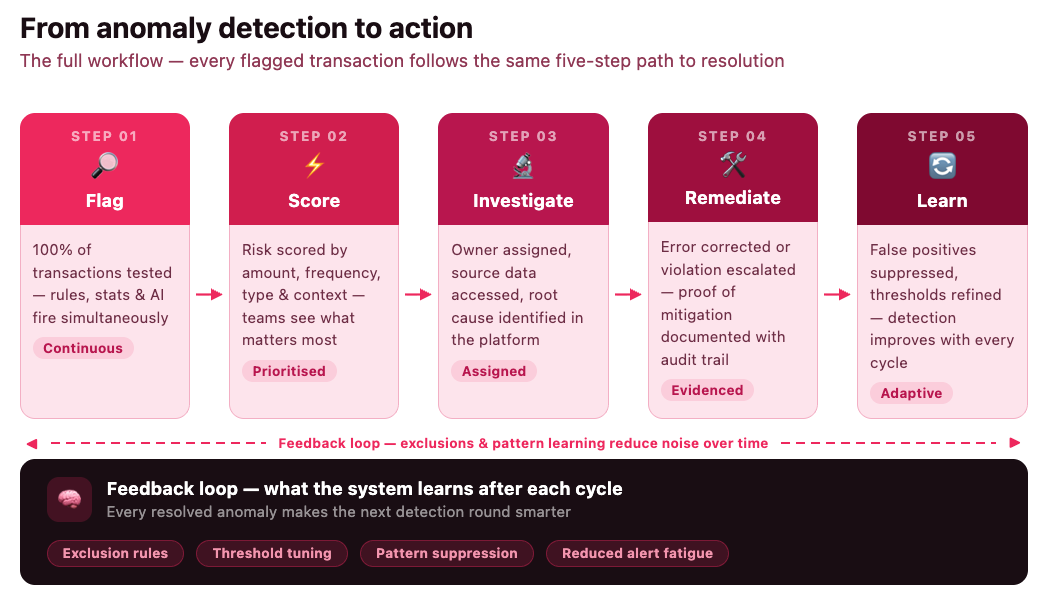
Transaction anomaly detection is the systematic identification of transactions outside normal patterns – due to errors, fraud, policy violations, or process breakdowns. It is the engine behind detective internal control and the input to continuous monitoring.

Why transaction anomaly detection matters for finance and audit teams
Manual reviews can't keep up
The ACFE 2024 Report to the Nations found a median 12-month duration for fraud schemes before detection. The channel matters most: tips detect fastest, internal audit second, external audit last. Systematic monitoring shifts toward tip-speed without depending on a tipster.
Sample-based auditing leaves blind spots
Traditional samples of 25–60 transactions cover roughly 0.001% of a typical large-cap general ledger. That is not statistically defensible against material misstatement risk; it is budget-defensible, which is a different standard.
Early detection reduces cost and exposure
A duplicate caught in the same month costs nothing to recover; twelve months later it may be unrecoverable. One undetected duplicate also teaches a vendor that subsequent duplicates won't be questioned, making that vendor a target for collusive fraud.
Regulators expect it
PCAOB inspection findings have repeatedly cited journal entry testing as a top deficiency. Pressure flows downstream to issuers, who increasingly demonstrate that controls were tested at the transaction level. Continuous controls monitoring produces that evidence continuously.
Types of anomalies in financial transactions
Anomaly programs pursue six families of risk – an extension of how internal control categories classify detective controls.
Duplicate transactions
Duplicate invoices, payments, and claims hide behind small variations – different invoice formats, flipped digits, one-day date shifts. The blast-radius rule catches what pairwise matching misses: a vendor receiving three or more payments in a cycle warrants attention even when no pair trips a duplicate flag.
Unusual patterns and outliers
Unusually large amounts, round-number payments, weekend postings, sudden volume spikes. Time-of-day attributes are underused: most ERP fraud is committed in business hours by authorized users, so after-hours flags catch ITGC issues more often than fraud.
Policy violations
Expenses above thresholds without authorization, PO-less purchases, payments to unapproved vendors. The most useful flag is not the violation but the near-violation – $4,999.99 in a $5,000 environment – which signals split-transaction risk before fraud crosses the line.
Segregation of duties conflicts
The same person initiating and approving a transaction; the same user creating a vendor and issuing payment. SoD conflicts have a half-life: a one-day conflict during PTO coverage is materially different from a permanent one. Programs that don't track conflict duration invert priority.
Master data anomalies
Vendor master records are the silent enabler of payment fraud. The single highest-yield rule is bank detail change followed by payment within 14 days – more fraud per investigator hour than any other master-data rule.
Journal entry anomalies
Post-closing entries, entries with no description, round-amount postings to sensitive accounts. The most fraudulent entries are rarely the obvious ones – they look normal in isolation but post in sequences that violate accounting logic. The IIA's GTAG on Continuous Auditing and Monitoring recommends journal entry analytics for that reason.
How transaction anomaly detection works: three approaches
The three core methods solve different problems and have different audit profiles.
Rules-based detection
Predefined rules test transactions against known scenarios. Rules are transparent and easy to defend in audit, but they decay – a $50,000-PO threshold will be defeated by users splitting into $49,000 chunks. Mature programs version-control rule logic and track decay alongside detection.
Statistical and threshold-based detection
Standard deviation, Z-scores, Benford's Law, and moving averages flag transactions that deviate from expected distributions. Most teams apply Benford to the first digit only; first-two-digit Benford catches more sophisticated fabrication, since invented numbers rarely follow the conditional joint distribution.
AI and machine learning-based detection
Isolation forests, autoencoders, and clustering learn normal patterns and flag deviations – covered in how AI is revolutionizing financial transparency. The blocker is rarely model performance; it is labeled training data – fraud vs. error vs. exception ground-truth – which most teams have never built.
Why the best approach combines all three
Transaction anomaly detection across financial processes
Mapping detection to accounting cycles makes a program practical – the natural extension of accounting and internal control discipline.
Procure-to-pay (P2P)
Duplicate invoices, vendor master manipulation, PO-less payments, price variances, payments to dormant vendors. The bank-detail-change rule outperforms every other P2P signal per investigator hour.
Order-to-cash (O2C)
Unauthorized discounts, credit notes, revenue recognition anomalies, billing errors. Credit notes are the under-monitored bucket – they reverse revenue without the scrutiny applied to the original sale.
Record-to-report (R2R)
Unusual journal entries by amount, timing, user, or account combination. Account combinations matter more than individual entries – a debit to deferred revenue paired with a credit to receivables is suspicious even when both amounts look ordinary.
Travel and expenses (T&E)
Duplicate claims, weekend expenses, personal expenses coded as business. The dominant fraud pattern is split transactions below approval limits, not single fraudulent claims.
Treasury
Unauthorized payment methods, unusual cash movements, reconciliation exceptions. First-time country codes on outbound payments are the strongest treasury signal – more so than amount-based outliers, which legitimate FX activity produces routinely.
From detection to action: what happens after an anomaly is flagged
Detection is the easy part. Disposition is where most programs fail.
Risk scoring and prioritization
Effective platforms score anomalies probabilistically, not categorically. A "high risk" flag with a 30% disposition rate is materially different from one with 90% – collapsing both into "high" sends investigators after the wrong queue.
Investigation and root cause analysis
Each flag needs an owner and a documented conclusion. The IIA's Global Internal Audit Standards require sufficient, reliable, and relevant evidence, meaning investigators must drill from flag to source document inside the platform. Cross-system investigation is the largest hidden cost in detection programs.
Remediation and corrective action
Errors get corrected, breakdowns get fixed, policy violations get followed up – each outcome documented so the audit trail closes the loop.
Feedback loop: reducing false positives over time
Exclusion management suppresses recurring false positives, but each rule is a potential blind spot – suppression needs its own audit trail. Precision improves with use only when suppression is governed.
Common challenges with transaction anomaly detection
Programs typically fail at the second or third maturity stage, not the first.
- Alert fatigue – low-priority flags overwhelm the team. Solve with risk scoring, materiality thresholds, and exclusion management.
- Data quality – dirty data produces unreliable results. Solve with automated ingestion and standardization.
- Multi-ERP complexity – different systems, formats, and practices. Solve with ERP-agnostic ingestion.
- Lack of domain context – pure statistical models flag year-end accruals as outliers. Solve with detection logic built by accounting specialists.
- No investigation workflow – anomalies are flagged but never closed. Solve with built-in assignment, tracking, and audit trail.
How to implement transaction anomaly detection
Step 1 – Start with your highest-risk processes
Begin with the cycle that generates the most risk or volume – usually P2P or R2R. Programs that fail almost always tried to monitor everything at once.
Step 2 – Connect to your transaction data
Detection requires the full transaction population, not exports or samples. ERP connectors that ingest data automatically make full-population testing operational.
Step 3 – Deploy pre-built detection logic
A platform with pre-built controls mapped to common scenarios delivers value in days. Customize thresholds to local policies and materiality.
Step 4 – Establish investigation workflows
Define who investigates, who validates, and how remediation is documented. Exclusion management is the biggest reason programs slow down – a P2P pilot generates 50–100 exclusion rules per quarter, and ungoverned exclusions become the next problem.
Step 5 – Tune and expand
Suppress false positives, refine thresholds, then extend to O2C, T&E, Treasury, and other entities once the first cycle is stable.
Conclusion
Most anomaly programs go through three stages: no detection, broken detection that over-flags, and tuned detection. The middle stage erodes trust faster than it builds value, and most programs that abandon detection do so there.
The fastest path through it is a platform that combines rules, statistics, and AI with disposition workflow built in – not just detection logic. Supervizor ships 350+ pre-built controls across every major financial process and supports the full path from flag to remediation, making risk discovery and fraud prevention operational in days rather than quarters.




.jpg)